Sunday, October 12, 2025

Oh, an IT Complex in Nilgiris?


Nilgiris has still a magical air to it.  Anyone who visits the landscape can't escape the moments of elation just visiting NIlgiris.  One has to ride through lush forests from whichever direction we chose to come from.  The valleys, the lakes, the farms, the tea estates, the plantations paint a magical tapestry.  While those who know Ooty and Coonoor from decades back talk about the charm that is lost, for the hundreds who come every day Nilgiris can still be magical.  Nilgiris is the watershed for forests in the plains - Mudumalai and Bandipur, Sathyamangalam to to the south east, Silent valley to the west.  The streams and rivers from Nilgiris eventually pass through the Delta, ushering in a harvest of plenty.  The zing in the N in Pongal comes from Nilgilris for sure.  

More than 700,000 people live in Nilgiris, more than 400,000 of them in urban areas scattered between Ooty, Coonoor, Kotagiri and Gudalur and the remaining in small and large villages within Nilgiris.    The tea and horticultural (vegetables and fruits) sectors contribute to at least 70% of the local economy, providing livelihoods to small and large farmers as well employment through corporate plantations.  Nilgiris has a prosperous air to it.  Villages like Kattabettu or Yellanalli have brightly painted homes, with cars parked along the road side, with the markets carrying every good and services one requires.  This transformation has taken place within less than a generation.  People want more out of life than just incomes from tea estates and horticulture.  Children have been educated, have gone through college and they need jobs.  It is surely difficult for parents to send them off to distant cities such as Coimbatore or Bangalore or Chennai.  Manufacturing industries are a non-starter in Nilgiris.  With many already working for the IT industry, would not a technology park in Nilgiris make sense.  On the face of it, it may seen like a compelling idea,  After all we need a building full of cubicles connected to the outside world through a fiber optic cable.

The problems start with location.  Yeddappalli village as the crow flies is 350 meters away from the forests that extend into Forest Dale - a beautiful blend of exotic plantations  and natural sholas that are part of the watershed for Wellington township.  Yeddapalli is about 500 meters northwest of Bandisholai another beautiful stretch of forests near Sims park feeding the Coonoor-Wellington watershed.  Yeddapalli lies upstream at an elevation if 2065 meters, while the 


forests slope across hillocks towards Wellington township at an elevation of 1865 metes   

Over a thousand people are expected to work in this IT complex, bringing in at least 500 vehicles into the already crowded Coonoor - Kotagiti road ,   At least 40000 litres of water would be needed per day at work, and another 100,000 liters per day at home.  For an IT complex to work, at this scale one needs at least a six to ten floor building.  Given the soft soils in Nilgiris and torrential downpours during the north-east monsoon an office complex in this location seems loaded with risks,  Clearly if eompleyment generation is such an imperative, and that too in a district which is 60% more affluent than the delta , any construction has to be in relatively flat terrain, within the municipal limits of existing townships where no further displacement of nature capital can take place.  An IT complex carved out of relatively levelled areas near the Ooty market could be considered.  Given the bus connectivity this would be  better than keeping a complex right where nature capital needs to be thriving.

Bangalore is the IT Capital of India.  It is not uncommon to see employees spend two hours to commute each way .  It is often the norm.  For the IT sector to thrive it requires people to people contact.  New talent needs to come and go.  In such a flux organizations adapt and grow, which brings us to should the complex exist in Nilgiris at all.  Why not Mettupalayam, the airport is less than an hour away.  There are trains connecting it to Kerala, Tamil Nadu and Karnataka.  Working three days a week at the office and the remaining at home is the norm.  Just an imagine, a commute to Mettupalayam, downhill at 7 AM, in time for work on a Tuesday and back on Thursday night, with calls and a workstation at home overlooking the mists and the clouds and greenery, and cups of tea.

It is really time to wear the Nilgiri hat and question the need for a TIDEL park by the woods in Yeddapalli, and plead with officials to find a better location , which generates jobs and opportunties for the youth in Nilgiris, while preserving the nature capital that still remains in Nilgiris.


Wednesday, October 1, 2025

Gandhiji and todays world


It was in the late 1970s, that my grandfather visited us in New Delhi.  His agenda was to spend time with us, visit a few Gandhian friends who were in the twilight of their lives nearly three decades after independence and visit Rajghat.  An otherwise authoritarian man with a stentorian voice would break down at Rajghat, showing his emotional side.  Yes, Gandhiji had visited their family home in Chennai, and that too for three weeks in April - May 1915.  My grandfather would gave just crossed 10 then; while his own father was a public figure, running a journal, bringing leaders together, publishing their writings, and maintaining a friendship with Gandhiji that spanned decades.  Among many memoirs, paintings, sculptures that dot my grandparents home, the most cherished is the framed photograph of Gandhiji and his wife with my great grandfather.

So Gandhiji was more than a distant icon, who fought for Indias freedom through non violence and won it seventy-eight years ago.  There was a familial connect that made me read about him, adulate him, defend him, critique his views and reimagine his relevance today,   There is perhaps so much written about him, elevating him to the level of sainthood, and some excoriating him and assigning the entire blame of partition on his name.  Considering the sheer weight of his achievements of questioning racism in South Africa and bringing about half a change during his times, to returning to India, joining and then leading the freedom struggle, developing new morally unimpregnable ways to fight injustice and oppression, of questioning everything within his society - of caste, untouchability, gender roles, class, treatment of animals, he has left an imprint which is hard to erase and hard to match.  

So what is his relevance in this world today?  I think the dismantlement of colonialism started with India in 1947.   Colonialism was morally wrong, politically indefensible, and economically difficult to sustain,  It took time for much of Europe to let go of their colonized states, but within 15 years much of the colonized world became free.  

However, even in countries that were ostensibly free, problems remained.  Reform was either painfully slow or non existent.  It took eighty five years for US to abolish slavery post independence , but post that African Americans in many parts of US endured humiliating segregation, without a right to vote till 1965.  These changes were brought about by Martin Luther King, who followed Gandhijis non violent methods, that of fighting oppression without giving in, and showing the morally correct path to American leaders.  Nelson Mandela was another stellar example of how decades of oppression could be reversed.  The fight against apartheid, and the violent incidents that surely underscored the struggle was conflated with the spread of communism.  Mandela rose through the clutter, embracing Gandhi's non violent ways to press for the dismantlement of apartheid.  And while doing so showed extraordinary generosity by starting a Truth and Reconciliation process so that the true freedom that South Africans enjoyed does not transform into a witch hunt against all whites.  Nelson Mandela's ANC was initially a violent movement.  And as long as there was violence, the government could resort to force to quell the movement, and paint at as anarchy spread from elsewhere.  During the polarized cold war era it was convenient to blame the Soviet block and overlook the moral horrors of an apartheid state.  It took Nelson Mandela, then inspired by Gandhiji to break the deadlock, just like Martin Luther Kind who accomplished this almost three decades earlier.

When one questions the relevance of Gandhiji today the answers are clear  When one examines the most persistent and violent of conflicts, where the morally correct answer is clear, it is the violence that obfuscates the path.  The genesis of Israel during modern times was clearly the decades of antisemitism in Europe culminating in the unimaginably evil Holocaust, forcing Jewish Europeans to flee to their roots and promised land under the most extenuating circumstances.  They occupied a land that was colonized by the Ottomans and then the British.  An Israel was created out of Palestine.  The Palestenians who saw this as their own land getting usurped fought back.  Several bloody wars followed.  Each aimed eliminating Israel, till the maps were redrawn in 1973, with Israel occupying Gaza Strip and West Bank, as semi-autonomous regions..  However, what is justice is known to all.  It took another two decades for Israel and Palestine to come to the negotiating table and come close to articulating a two state solution in the early 1990s.  But violent forces from the fringe took over, and Israel and Palestine got pulled back from the summit of peace to the precipice of perpetual war.  It takes extraordinary resilience and courage to defend a small country against countless barrage of missiles from Gaza or Lebanon or Syria.  But it also speaks of unfathomable retaliation against opponents every time this happens.  The current events in Gaza are an unfortunate culmination of the waves of violence and retaliation that have marked this conflict.   Could there have been a Gandhiji from the land  If the intifada that precceeded the OSlo peace accords was non lethal and essentially non violent, could not there have been a more sustained movement for peace?  To recognize that Israel as a nation needs to exist where it stands because the followers of one of the most ancient of religions were almost exterminated during the Holocaust.  Cannot Israel recognize that Palestenians who existed as a colonized people needed their own country.  In this din, the day to day stories of coexistence remain buried.  It is violence that obfuscates,.  It is violence that prevents any reasonable pathways from unfolding.  It is violence that brings out the worst in human beings.  Gandhiji saw that very early in his life as he read the Gita, War and Peace, the Bible, and showed the way.  What will it take for a new Frontier Gandhi to emerge out of every conflict and show the way

Any unabashed adulation of Gandhiji the man faces the risk of becoming another fundamentalist dogma.  Given his immersion in the freedom movement, and solving Indias inequalities and injustices, he was not the best reader of world affairs. I do not know whether he came out and stood against the holocaust and showed a more nuanced understanding of the problems in the middle east. He died just when the seeds of the conflict were beginning to bloom, his views had such an overwhelming shadow that it took decades for India develop a more nuanced understanding of the middle east,. 

India lives in its villages, but casteism in rural India is as fertile as the gangetic plains in its villages.  A modern economy, with pursuit to education, jobs in manufacturing, retail, technology  and services is the best pathway to a society that is free from the shackles of caste and class.  I do not think India's leaders could gave envisaged in 1947 what India could have looked like today with at least its urban economy - not necessarily perfect but much better for the country as a whole.  It took a Nehru to recognize that start modernizing the country. The seeds of modern India were sown by him, while taking Gandhijis ideals of secularism and equality as the very core of India.  

That said, in a world replete with hateful ways there was one man who showed the path forward.   His ideas were not only his own, it was a synthesis of many streams of thought that he remained open to.  The message of non violence and fraternity above all remains an ideal that is hard to shake off.  At least in our India.  The ideal of keeping a mind that is open to all streams of progressive thought, and synthesizing them into our own framework is another.  Facing up to injustices and finding a better way is a third.

Thank you Mohandas Karamchand Gandhi

Friday, September 26, 2025

Is it time to play with a straight bat?

 The last four months have seen India in a sticky wicket, against some hostile bowling from DC.  Our smugness is coming apart from its seams.  Have we lost the art of leaving the ball alone.   Of ensuring that we play with a straight bat.   Sometimes the pitch is undone by the playing 11 and at times by spectators with business interests..


Let’s start with 2022.  A little country gets invaded by a big one.   While we wisely kept out of it in the U.N. we upped the crude oil purchase from zero to 38% of the total mix and it worked as long as we were not in the spotlight.  But we wanted to walk with the swagger of Viv Richards on world stage and the rather partial umpire shouted tarriffs in the middle of a trade war.  Switching to Russian crude was wide off the mark.  That was a ball we could have left alone, soften up the bowling, and quietly caress the ball later for runs. But all the grease has made the wicket nasty.  Is it time to quietly relay the pitch .


The second problem was H1Bs.  A visa system that was meant to attract the very cream, in areas where US is lacking..  chemical engineers who can decipher reaction kinetics while simulating turbulent flow,a  medical researcher that can unlock the autoimmune condition that eats up one’s own nerve cells, material scientists that can invent alloys that make a killer aircraft engine.  Instead Ranji trophy and club cricketers and the like somehow clutter up the queue to do coding jobs under H1B.  I don’t think the Indian government is responsible, but our private enterprises gloss over the letter and spirit of H1B, and now it hits the fan.  


So it is time to settle down and play better cricket,    Leave the greasy ball alone.   Be generous to the grizzly bear, tell them that the Teslas and F120s and Harley’s come in free.  A handful may buy it..  and tell that Chevy Malibu is the best car in the world and play cricket.  With the humility and class of Sachin, with the guile of Prasanna, with a straight bat  and decency like Dravid, with the calm courage of Dhoni.  


Saturday, September 13, 2025

To fly like a metallurgist.

Retirement allows one to wheeze like an old wheezer.  While I was in the middle of an asthma episode i get  a call from another retiree who swings golf clubs when free saying why don’t we make our own aircraft engines.  Aircraft engines represent that final frontier in metallurgy.  

The journey probably starts with a propulsion model that provides a system level look of the engine comprising of a turbo fan, which sucks in air from ambient and sends it aft, some through the core and the rest to bye pass the engine whose only purpose is to generate thrust.  The passage of air ingested through a low pressure compressor, high pressure compressor, combustor, high pressure turbine and a low pressure turbine.  At it’s heart is the Brayton cycle that takes in compressed high pressure adiabatically heated air from the compressor into a combustor,  mixing it with fuel and burning it to generate high velocity combustion gases at temperatures that can exceed 1500C. Very close to the melting point of the alloys used.  The high pressure turbine extracts part of that energy converting it to rotational energy which enables the compressor to compress ambient air to higher temperature and pressure and providing further axial thrust as the combustion airplane travels to the aft of the engine.   Further energy is extracted in the low pressure turbine till almost all the useful energy is extracted and the combusted air exits.  Remember the turbofan?   In a commercial engine it is the biggest part of an aircraft engine.  90% of the ingested air travels aft bye passing the core generating thrust.  It’s only 10% that travels through the core, getting compressed, burning the fuel to provide energy for the fan to rotate, and finally exiting as hot air and providing the thrust.  In a military engine we need speed, acceleration, manoeuvrability.  The turbofan is smaller.  Most of the airflow goes through the core; to get the added acceleration an after burner is added at the exhaust.  When fuel is introduced there with exhaust gases already at several hundred Celsius the energy released is tremendous.  The exhaust gases accelerate as they exit, generating tremendous thrust and acceleration.  The Mach 2 velocities come from the after burner. 

Thus from a system design as described above one comes to the mechanical design.  Where each sub system, the compressor, the combustor and high pressure turbine and low pressure turbine is broken down to components.  Each component is reduced to a finite element mesh, where each mesh point is defined by stresses acting on it along with the prevailing temperature. The stress-temperature is in essence an ask from the selected material.  Can it withstand the conditions at each mesh point taking into account failure modes,  yield strength, fatigue strength and creep strength, along with oxidation.  Since each subsystem, such as compressors, turbines and combustors are actually an assembly of components, some welded, some bolted, many sliding to form a fit, relative motion comes into picture and wear remains a matter of concern.  In the high pressure turbine, temperature are so high that it takes a combination of thermal barrier coatings and cooling airflows to keep temperatures where known alloys can operate.   Thus translating the design to practise becomes an exercise in materials selection. 

The rubber starts to hit the road here.  The jet engines we or our parents may have first flown in the 1970s, five decades back still in a Boeing 747 consumed twice the fuel and generated half the thrust compared to the same engines today per passenger kilometer.  Technology has advanced relentlessly.  And with it, so have the designs and materials used.  

So this brings us to why can’t we make an aircraft engine?

Are our designs up to speed. And do we have materials that meet those needs?   Can we manufacture those materials with the required integrity?   Can we life those materials and predict how long will they last.  

The purpose at this point is not to provide a yes or a no to these probing questions.   But articulate a possible strategy to get there.  A cursory review of open domain literature will give us compositions of alloys used for compressors airfoils and disks  turbine airfoils and high pressure turbine disks.  Our first task is to ensure that critical alloy families can be manufactured to the end geometry.  By the required process; disks are forged, high temperature airfoils are cast as directionally solidified grains or as single crystals.  The national labs serve as nuclei where some capabilities exist to cast airfoils as. Single crystals or directionally solidified.  High temperature rotors have alloys which start as powders which are compacted and forged to provide defect free components with required composition.   Can the technology be transferred to a select few private sector companies.  Can private sector companies step forward do their R&D and make the first entry at the component and subassembly level.  

A target for this exercise is to at least reach a point where the select world leaders were at 2000.  In 2000 a twin engine aircraft could fly from London to Singapore.  This could be our Maruti moment in aircraft engines.  But while we are catching up in manufacturing our scientists need to design the next gen aircraft engine with new materials.  The infrastructure created for manufacturing needs to be advanced to make new materials. Simultaneously we need to advance subsystem  level testing capabilities so that designs and manufacturing are continuously validated. 

The road ahead is long.  The key cultural shift that needs to happen is that we need to be ruthlessly honest and recognize the current status and the efforts needed.  But we need to be confident.  Knowing that once we enter the arena we will succeed.  Even if it takes 20 years we will prevail. 

Dr.  Anand K
GE Retiree 


Thursday, September 4, 2025

A Teachers Day

 Been blessed with great teachers.  A clear but low key”oxygen is a supporter of combustion but not a combustible gas” rings in sometimes even today.  Her name was Susan.  She was as balanced as her equations in chemistry. In College, we had a fair, semi bald headed, with curly hair at the back, teaching physics tell us on October 1st about what Einstein thought of Gandhiji, a physics teachers opinions on someone who held the moral compass. That was Popli…. While I had a bunch wonderful teachers in IISc, here is a special one for Dr Kishore, who would show up at 8 pm on his Rajdooth to see how my experiments were going and ask whether I had dinner.  .. he would take me bike to the machine shop to get the discs ground.  A gentle pat on the back helped me change track from being an aimless wanderer with an engineering degree to someone who fell in love with research, with Tribology, that has stood the test of time and kept me relevant 44 years later.  In IITM it was KAP,  whose concepts  on tensors helped me connect to Peach Koehler formula but more importantly learn who to facilitate others in their pursuits setting aside organisational imperatives.   If KAP reads this he will know. 

During my PhD it was Conrad who hung on to concepts that I had uncovered which Scattergood  nudged me towards, helping me rise from a “oh will i get itmy PhD” to here is a good one.  Kosel in Notre Dame got me to come completely out of my comfort zone, measuring velocity of 100 micron particles rebounding in all directions with a true focus on the fidelity of physics.  

Can a teachers day be complete without writing about Jerry Schell, who knew whether, how and why and where components underwent wear in an aircraft engine and was willing to mentor and teach to anyone who showed up at his doorstep at the end of a 11 hour day.  In those few years I was a pupil again in love with my field, and the engines and coatings and everyone who worked around me. 

I think this continued for life   Finding that Guru in every organization.  There was this Dr Otto Schneiper who knew about every application for thermal sprayed coatings in the industry and tell me about the value story it offered.  

At some point as we get older our ability to soak knowledge like a sponge becomes equal to or less than what we impart.  When we impart do we put blinders on how, or whether we learn?  In my world today i continue to learn from the team, i don’t blank when people talk about repassivation or microstructure based lifing or life limiting locations, or on how to review programs.  But assuming the mantle of a guru should not come in the way of becoming a shishya, a sponge who wants to soak all the knowledge.  


On that note, a Happy Teachers Day.  Happy Pupils day.  Keep your pupil wide open. 

Saturday, August 23, 2025

Back to that 1S2 Orbital.

 So here I was back in Chennai.  A place that we went to because the family was there.  My grandparents.  My dad and mom. Aunts and uncles.  In those old neighbourhoods where the trees were older than grandparents. Verdant.  Everywhere.  Spreading their canopy, and enveloping all in the comforting shade.  


A city so enclosed and ensconced that everything seemed a twenty minute commute.  Now in airconditioned Ubers


No wonder that those who found comfort in such stable states never left the city.  I know some who escaped to higher orbitals who returned back to their core.  Their 1S2 state in the C atom, Chennai.  Organic to the core.


Where would that place me?  Like many others who seemed to have escaped the inner orbitals to find higher energy states.  Consigned to find that higher activation energy in some other country or some other city?  


 I think i find solace in the metallurgical bond.  Relishing in donating and being surrounded by free electrons.  Like those free electrons i find my belonging everywhere, in the cool or warm and humid canopies of Chennai, in the new rootedness of Cooke Town, in good earth which seems to have goodness transplanted from everywhere across, and in Whitefield surrounded by young and old with pulsating talent.  Or when I visit US where the nostalgia of different phases of life envelope me. 


It is good to be a free electron in that metallurgical world. 


Every now and then tunnel into the core orbitals and come back. 

Saturday, June 28, 2025

Pondicherry hues

 A quiet birthday to celebrate the 78th birthday of my mother in law got me to escape the humdrum of life in Bangalore.  A bit of a circuit.  By train to Chennai.  And a cab to Pondy.  It had been a while, those train rides. 

It had been a while to Pondy too  

My Vande Bharat pulled out on time, the guy floored it past KR Puram   The display said 130 kmph and Whitfield was a blur.  The gentleman next to me was well turned out, with a little red dot on his forehead, like gentlemen from Chennai often do.  I nodded to him and went back to my messages till out of boredom we stuck a conversation.  He ran a business.  Believed in simple living. He wanted to know about my career in GE, about airline safety, referring to the recent tragedy of course.  And then things drifted to fate, Gods way, creation, statistical thermodynamics, order and disorder in life and society.  A couple of hours drifted by   A kid in the next row offered us chocolates   Her mom wearing a headscarf turned back and smiled at us   My neighbour rummaged through his laptop bag a pulled out a chocolate   The kid threw a glance at her mom, her mom nodded and said, oh thank you so much.  My heart felt a bit warmer  

I have spent much of my life being my own self, never quite putting on an act, i think.  And surely after nearly four decades of married life a visit to my in laws felt like home.   The road to Pondy from south of Chennai was a ripper   At 100 kmph one was keeping up with traffic   Past verdant roads, wooded hillocks we were soon near Pondy   Into that warm liberal enclave where there was a bit for everyone  

The ashram perhaps sets the tone   Order disorder, chill, loosen up, be yourself it seemed to say   And so the visitors and residents seem to be able to slow down more than a tad to soak it all in.  The promenade amid the rocky  beach   The pastel coloured buildings, quaint little cake shops, restaurants serving continental cuisine with a chilled mug if you want one, all had the unsaid message.  Unwind   

As did Maisone de Perumal, with it’s dual open courtyards, with large pots housing small trees, and gentle piped music with men wearing dhotis and rooms immaculately furnished, and a kettle with a French press for coffee.  A room that was truly nap-worthy and certainly a wonderful brew to wake us up.  And thus flew a day and a half with walks to the beach, the French quarters, morning runs, walks to the temple and of course the ashram  

And that morning for breakfast, Maison whipped out a cake   The ID proof was not just for compliance but to note down those special days  

Those hues of Pondicherry   Still wrapped in it  


Wednesday, December 4, 2024

Greewashed in Baku


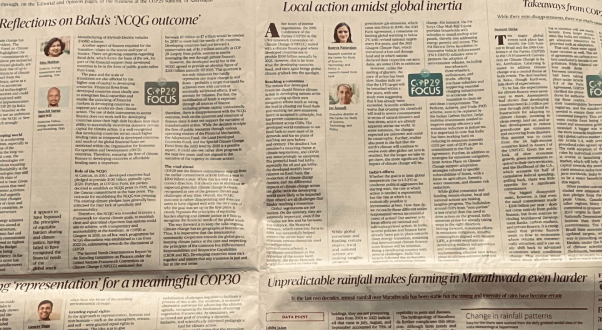
There were four center-page articles on COP29 conference held in BAKU in a major newspaper, pouring into the looming global warming crisis, the need for developed countries to spend more  on aid to help developing nations adopt climate change mitigation technologies,  and how we could be entering an era of NCQG - New Collective Quantified Goals.  One of them talked about India's major role in spending as much as 15000 crore rupees - about 0.06% of its GDP on renewable energy!! 


That we were about to breach 1.5 degrees Celsius rise (we are at 1.49 degrees C now) post commencement of the industrial age was mentioned in passing.  And 3.1 degrees Celsius temperature rise could be breached if we continue along this trajectory.  Barely a few months ago we talked about 1.5C rise as a defendable goal if only we went on a full court press.  It is unfortunate that we have an underpinning premise is that we have the answers, if only we had the will to deploy them; but the premise is simply not true.  One more reason to state the obvious.  We have been green washed.   This time from Baku.


Let us consider Renewable Energy, which decarbonizes the energy sector.  More than a decade ago, Photovoltaics (PV) reached a cost point where the installation costs per rated MW was on par with or less than new thermal power plants.  Wind energy was not far behind.  In India, investments in renewable energy outpaced conventional power for more than a decade, with approximately 70GW being added in thermal and 120 GW in renewable energy.  Renewable Energy accounts for 46% of installed capacity.  Yet in terms of energy generated thermal power is still a whopping 75% of the energy mix.  Renewable energy is seasonal (especially wind) and not 24x7 - Solar.  The ratio of delivered to installed capacity for renewable energy is about 30%.  Transmission losses are 2to 5% per hundred KM - so to put all solar in the deserts of Rajasthan is not practical.  To deliver 100% Renewable energy leveraging on energy storage while increasing capacity to compensate for the intermittency of renewable energy, one needs to triple the current renewable energy footprint.  We will struggle to find the land for that.  And battery-based solutions come at a prohibitively high cost (will quadruple the energy costs) and comes with its own carbon footprint which may take years to erase.   Pumped storage is often talked about.  It needs two reservoirs at different heights in reasonable proximity, with enough watershed to store the 1000s of MW of energy that needs to be stored.  Indias current hydro capacity is 10% of its total footprint and only a small fraction is amenable to pumped storage.  Pumped storage comes with massive ecological costs in terms of deforestation, and impact on aquatic life.  


In-spite of a decade of concerted action we are stuck with 75% of energy on tap coming from thermal power.  This conundrum is not unique to India, USA, China, much of Asia, and portions of Europe share this problem.  The exception is those blessed with 24x7 wind (Netherlands and Denmark) or those with massive legacy nuclear energy (France and Ukraine), that have breached the 50% ceiling of non-fossil energy-based power.  There is only one water-tight solution - that is nuclear energy, which is 24x7, minimal carbon footprint except during construction, and comes with a safety risk which is manageable.  Stray radiation from mining for coal or lithium exceeds that from standard nuclear plants.  Small nuclear reactors (SMR)are even more manageable when it comes to disposal of waste.  If the world is serious about climate change developed and developing nations should be forging a partnership in installing nuclear power plants, including SMRs which can be deployed quickly.  And this should have been one of the main talking points.


Moving to transportation, EVs that are not directly tied to solar panels rely on grid power which is now 75% thermal across much of the world.  The batteries come with its own manufacturing carbon footprint which is much higher than conventional vehicles.  The energy storage materials have a 3% extraction efficiency, some are mined at the expense of rainforests using primitive methods.  The total emissions footprint of battery manufacturing is estimated to grow to One Giga ton of CO2 per year - it is estimated that for a 100 KW powered EV (like a tesla) it would take 70000 KM of driving to neutralize manufacturing footprint.  Yet there is a case to be made for EVs if the energy used to charge is 100% renewable.   Two wheelers and three wheelers which take a few hours to charge and readily done in daylight could be 100% emissions free, and pollution free, if they are backed by dedicated solar energy.  For a 70KWh hour car it requires 10 KW of PV or at least two thousand square feet of space and eight to twelve hours of time to charge and finding that space is not easy in urban settings. The easiest answer for India is that it makes sense to electrify the two-wheeler segment and that is part of the policy prescription.  For the rest it is a struggle to electrify.  Increasing the percentage of biofuel, especially from waste, is the best mitigative answer unless one switches to nuclear energy instead of thermal power, which is clearly decades away. 


If the challenges are that stark, and immediately implementable solutions are that difficult, then the question is how societies can strive to mitigate climate change.  


Rooftop Energy.  This could include solar panels on rooftop or sunshades in every home, biowaste to energy in rural areas using small gensets, backed by tax breaks or subsidy from the government.   The goal should be that at least 40% of domestic energy needs in rural and urban areas is met by locally generated renewable energy.  This certainly would pose challenges to grid stability and thermal power plant reliability, but this can be managed.


Energy Efficiency:  The lowest hanging fruit has been plucked - much of urban lighting comes from LEDs which consume 10% of the energy of incandescent lamps.  Appliances are more efficient today than a decade ago, even in India.  However construction industry is locked into bricks and concrete even for non-load bearing structures - industrial waste to walls is a significant opportunity which needs to be tapped.

When it comes to thermal power, India is struggling to unlock itself from technologies which are inherently less efficient.  Existing coal fired Rankine cycle engines have 50% higher emissions as compared to combined cycle natural gas fired power plants.  However, India is a nett importer of natural gas.  Coal gasification, and coal to natural gas technologies need to be tapped and deployed with alacrity to reduce emissions from the energy sector.  Such a move would help India migrate from the less efficient Rankine cycle to the more efficient combined cycle which combines Brayton and Rankine cycles.


Optimizing India's farming:  Farming from existing irrigated lands or those areas blessed with abundant rainfall needs to be maximized and made scientific to maximize yields.  India has already closed the gap in wheat and is catching up in paddy.   Fifty percent of India's farmlands are not irrigated by rivers.  Large scale dependence on ground water is not sustainable or energy efficient.  India needs to switch to a combination of drip irrigation with millets, horticulture and agro forestry in such areas to maximize rural income reduce energy footprints in agriculture.  In a prevailing democracy such as India, such rules cannot be imposed from top, but there needs to be incentives from the government and markets. About 20% of horticultural produce is lost because of lack of cold storage.  The use of renewable energy (evaporative cooling) can be a game changer and needs to be developed for small farmers.  Finally agro-waste to ethanol needs to be developed so that Biofuels are sourced not just from water guzzling crops like sugar cane but actual agro-waste.  The farmer apart from being part of the food supply chain can become part of the energy supply chain with the right incentives for rooftop / pump head solar, and waste to energy or fuel plants.  By focusing on yields that reduce the area that needs to be farmed along with agroforestry, rural land banks could be coopted into nature-based climate change solutions with transparent policies that directly reward the farmer.  


Responsible Consumption:  India is a developing country - poverty is a lived reality.  When poverty exists in combination with caste and class divide, the loss of human dignity is morally unacceptable.  One needs to recognize that urban and rural consumption generates jobs in all sectors.  But there is a case to be made for responsible consumption.  This includes the shift away from larger fuel guzzling cars, frequent upgrades of electronic gadgets which have large manufacturing and transportation carbon footprints, investment in property which carries its own construction related emissions, and flying to destinations where surface transportation was possible to name a few.  About 10% of India's households now have first world lifestyles, and this is driving emissions.


It is said that if all of India lived in urban settlements such as New Delhi, then the entire population could be bottled into a small state such as Telengana.  Of course the country needs its farms and factories.  Therefore, while balancing technologies used for production of engineering goods and apparel, or food grains and horticultural products, one needs to ensure that land usage is kept to a minimum.  If we make substantial changes towards that end we may see more if India becoming a forest and contributing to mitigating climate change through nature-based solutions.


Until we do all the above Greenwashing will continue.


Saturday, November 2, 2024

Those lanes of inclusion


Our shop is as organic as it gets - has only grains, fruits, vegetables and dairy products. Short eats are locally made and certified as organic,  So for a shaving cream it needs to be an errand in sin to an inorganic shop, unless one uses an App for delivery.  But a part of me still would want to get out, past the leafy road to periurban Bangalore, all a hop away.  Cows on the road, strays near garbage, two wheelers and four wheelers in Brownian motion from gated apartments - I get to my inorganic shop - well stocked with detergents and soaps, along with food grains and junk food from assorted sources,  I would typically find smaller shops that sell peanuts and the like, a medical shop run by a disabled person - it breaks my heart to ask him for anything outside his reach, but he has a smile and he says he needs to make business.  Today the assorted shacks selling fruits and vegetables were closed, and I was determined to give the small timers a shot,  And so I head towards the main road and try and find push carts that had fruits.  They were gone,  I take a left  hit the main road and turn left to Anchepalya - another street in random motion with a mosque, temple, medical shops and shacks selling wares jostlling for space,

Guavas slightly bigger than a baseball caught my eye.  So I pulled over and stopped.  This guy had apples, oranges, guavas and bananas.  While oranges looked far from fresh the rest were good.  Got a Kg of each - I knew this guy would know hindi, spoke to him in Hindi, paid in cash for old times sake, and then my eyes wandered to the temple to his right.  He gave me an extra banana, peeling it saying this would be good.  It was.  The temple like the many small ones in Bangalore had a majestic tree.  It was 2 in the afternoon and it was closed.  On it steps there were kids playing.  Their mom in a burkha kept a watchful eye.  I had my bagful of fruits and a smile - these lanes can give social media a lesson.

In a couple of hundred yards, the road would turn to the right - and become less crowded, with a new temple to my right, a government urdu medium primary school which also hosts elections every time it is held, a Benedectine monastery to my left, it hosted a zen meditation retreat earlier this year.  Another left turn and I would be back to my leafy oasis.  Our new additional household help, a muslim lady went early on October 31st to buy firecrackers for her kids.   

Is it just my neck of the woods?  In Nilgiris where we are running an NGO the labourers, tribals from Masinagudi wanted a week off for Diwali.   The program was kicked off as per their custom with a puja for the implements that give them livelihood, while the staffers irrespective of whether they went to a church or a temple wanted to by firecrackers for the kids at home,

And so unfolds the mosaic of India, seen from a community called Mosaic.  The community is called Malhar Mosaic.  A song may be in order, but rendered by me would be surely unmusical.

Thursday, October 10, 2024

This time we say TATA to a great one..


Tata old friend

The first time I admired an engineered product from India was in 1977.  Most of Haryana and western UP was submerged in waist deep water.  As students from Stephens we volunteered to distribute food packets to those marooned along with tablets to purify water.  We were bused to points where Tata trucks stood.  We climbed at the back like laborers, perched on the side as it went past flooded roads, pushing a large wave of water ahead.  The drivers were experts , they had points where they would stop where we would get off, wade on water and get into boats that got to marooned villages.  We had the same roti and aloo subji.  But I looked at the truck, built like a rock  and said wow..

The place where I did my undergraduate engineering course was called Tata Institute, founded by Jamshedji Tata - a place where excellence and thought leadership was carried forth as though it was all but natural.    Like Tata Institute of Fundamental Research, Indian Institute of Science, Tata Steel and Tata Motors, building national icons seemed just par for the course for the house of Tatas.  My education in engineering was in the early 80s.  A revolution in how educated India would work was quietly underway.  The best from BE Electronics and Electrical were getting absorbed in Tata Burroughs Limited, a company that pioneered a career in software and coding - with engineers stationed in India or overseas coding and making the world run.  Ah it is Cobol some would remark,  But it was a new way to live, thrown into challenges at work, exposed to new cultures and new norms.  Educated Indians took naturally to such challenges.  Many others followed.  I started hearing of new towns like Culpeper and Charlottesville.

It was still the 1980s right?  A third world nation eagerly trying to fit in.  While we applauded ourselves in cutting it, there were others among us dreaming bigger,.  Cut to 2000, and Tata looked as big as one of the  businesses of GE - a $12 billion business.  Wow we said.  While GE was priding itself in having one of the largest R&D centers in the world, A JV with Tata gave great design engineers.  While new MNCs occupied an entire floor TCS was having much larger office spaces.  Advanced computers were sold by Tata Elxsi, our guests stayed in the Taj Westend or Vivanta - hotels that remained peerless in levels of service class and comfort.  

Engineering companies like GE were taking pride in building world class teams in India.  While we  were marveling at what was getting accomplished, Tata gave graduate courses in Audacity.  Tata tea, the benevolent owners of large tea estates bought Teltley.  Tata Steel, which was one of the largest steel mills in the world bought Corus.  While Tata Motors had Land Rover  and Jaguar under its belt.  Its 2000 launch of Indica sounded like a math problem - more car per car.  The ambassadors got replaced by Indica and Indigo.  While they were not a Honda by any stretch, the logged in the miles - the tax driver who took me to the airport after India beat Sri Lanka in the world cup had already clocked 400,000 on his Indigo.  While we had our symposium on how the best technologies could be harnessed for India, we had a Tata Nano test drive - meant to get Indians to get off their unsafe scooters and take their families in a Nano.  Two decades into my career, our daughter makes it to UK.  The Paddington express from Heathrow had TCS written all over it. 

My first and only visit to the house of Tata was to meet a friend and mentor Gopi Katragadda.  A small non descript building in a busy street replete with hawkers, with an Indie accompanying in the lift told me a story of inclusiveness and humility. Yes we know about the trusts and charity that have stemmed from this house.  Of audacity and scale and span coming from the house of Tatas.  Their son made much of this happen has moved on.  

I write this blogged more moved by his passing than any public figure I have known.  

Tata - to our icon. 


Sunday, June 16, 2024

Oh Can't we See??


Oh Can’t We See?


Back in the 1970s, still wading through Watergate, Vietnam War, and  past  the civil rights protests, rock and roll came into its own.  With searing music, exploring strands from across the world, and asking searching questions.  Can’t you see was a one hit wonder from a relatively obscure band.  While it seems only a break-up rock song, its guitar work, flutes, and vocals were indeed haunting.  That “Cant you see” being a metaphor for “Cant we see?”  directed at those of us dreaming of a better India,


In terms of financial bandwidth, we have moved on.  When P Chidambaram presented his dream budget in 1996-97 for Rs 100,000 crores with the 20% each already allocated to servicing the debt, funding the states, funding defense, and paying salaries for government staff, he had only Rs 20,000 crores to develop the country - about Rs 200 per capita.  With such meagre resources, even a single flyover over one intersection was a luxury.  We seemed forever consigned to third world existence, While poverty was an un-mutable fact, what could be challenged was the swing to the right.  The horrors of the violence that we were witness to in the early 1990s kept us transfixed on what should or should not be the agenda for the country.  Like deer caught in those headlights we have not moved on.


India’s economy has certainly grown leaps and bounds,  The interim budgeted this February has a government spend which is 47 times higher than that at 1996  ..  at 47 00,000 crores.   While in 1996, we the consuming middle class were barely 10% of the population. Our influence on national politics was limited.  Who gets voted to power depended on the poor.  But much has changed since then .  With 15 million two wheelers and 4 million cars sold every year, the aspiring classes are at least 500 million strong – less than 40% of the country, but our voice carries, through the influence we wield on social media demanding amenities from the government, and the loyal discourses that we sustain through whatsapp university.  It is to this segment that I ask and  to those in the liberal left and the pro-establishment right – Cant’t we see?


If one were to Pareto out the problems that Indians face, it is lack of access to dignified housing for the urban poor – about 100 million Indians live in slums – in small shacks with poor sanitation, schooling and health care.  It is amazing that while Mumbai glitters like Manhattan, with more than Rs 100,000 crores spent on sea links and metros, the poor continue to live in such poor conditions.  The same applies across metros and tier 1 and 2 cities in India.    The problem is also one of a poverty trap that over 50% of those in rural India face, There is a paucity of jobs in India, Support prices of crops have not kept up with inflation for more than a decade.  Infrastructure for storage of agro-produce is non-existent.  Opportunities to augment incomes through distributed renewable energy (solar panels on roof tops and irrigation pumps), solar farms in fallow lands, biofuel and energy from crop waste have been frittered away in favour of Renewable Energy projects favouring a few large industrialists.  And those in rural India have poor access to schools, colleges and education.  In many small villages education is available only to primary and middle school.  Overcoming such barriers is something that the poor cant afford.  If one throws in caste structure into the mix the problem is even worse,  While climate change is an elite problem ripe for discussions, it is a lived crisis for the rural poor,  Climate change and  the normal vagaries of monsoon seem to have colluded to throw up either a cycle of relentless drought or destructive floods,  Large scale government and private intervention is needed to address this issue, to augment Renewable Energy for non-industrial use, and increased reliance on agro based biofuels for transportation.  If technologies for the same are invested such that the value add is at the farmers door step the near permanent poverty in rural areas can be redressed, It is the absence of ideas, policies and investment in this space that results in migration of millions to cities for a better livelihood.


While the agenda required for the country is clear, we have an almost Dystopian fight between the right wing and liberals over religion.   If one were to focus on day to life for the millions of the majority and minority, the rights to worship, attire, identity is fairly unfettered.  The banks in India shut down for Good Friday, while in US they do not.  Our stock markets close for Eid and Guru Nanak Jayanthi.  Each religion has its own civil code and rightly so, to be challenged only when individual rights are breached.  What we fight over and take cudgels with and rightly so, is on incidents of violence.  That said the elephant in the room is that at least 30 to 40% of the population is trapped into poverty with limited recourse for a better life.  And another 20% are just one crisis away from a slide back to destitution.   


Yet in the kaleidoscope of issues that I see being debated in the press, on TV and social media, it is – mostly focused on religious divide, whose single biggest benefit is to help us voice opinions which are in tune with our identity markers.  I feel like again screaming – “Oh Can’t we see?”  Because real issues are lost in irrelevant echo-chambers.  While the poor really struggle to live in dignity across India.


Saturday, April 20, 2024

A Travelogue - and Systemic versus Incidents of Exclusion


Systemic versus Incidents of Exclusion


Went through 25 days of charming and exhausting days of travel spanning three countries.   At 1:00 AM the roads in Bangalore were smooth.  The Toyota Etios cab seemed as spacious most in US.  The AC worked well.  Our previous Uber in NY was a Tesla with a translucent sunroof.  The car was driven by a Nepali Sherpa – his last name as a sherpa.  An hour of commute was peppered with conversations about US and India and Nepal and treks   The Uber drivers in US and France seemed to come from many countries – and many religions.  It is said that the US is a melting pot – and so it is.  Different cultures drawn from across the world seemed to melt into this pot, and come out homogenized, mostly accepted, and mostly conform to an American identity.  Any person who intends to live in the US – student, visiting professionals, immigrants implicitly subscribes to such a model.  While personal freedoms and privacy reign supreme, the question is, are there unsaid  limits to expression of identity of the sub-cultures they come from.  But the collective American identity in its intent is inclusive – so how much is lost.


India had started with a different legacy.  Being a tropical country with abundant resources – of spices, textiles, crafts, India was one of hubs of global trade for centuries.  Buddhism emanated from its shores and spread to many locations – especially the far east.  Hinduism found its branches in Cambodia and Bali.  Christian, Zoroastrian, Islamic and Jewish traders immigrated and thrived along India’s coast.  While there were chapters of invasion and colonization.  The prevailing culture in India, at the time of independence in India was a mosaic – of cultures, languages and religions.   The founding fathers of India protected this legacy fiercely.  Many liberals including me carry the torch farther, taking the enormity of space and freedoms given for religious and cultural expressions granted, barely acknowledging  what has been preserved since 1947, and what has been carved out as an Indian version of diversity and unity for centuries prior.


France was our first port of call.  The city taxi cab counter at the Charles De Gaulle airport had its string of drivers who accosted us saying there is heavy traffic and it is going to take 90 minutes and therefore a fare of 140 Euros.  The Uber app mentioned 66 Euros.  After plenty of back and forth with cancelling drivers we found one who asked us to come to the departure gate.  We got dropped an hour later at the hotel.  The hotel was managed by an immigrant of of a French colonial origin.  With long locks, excellent English, and helpful to the bone – he got us the room, offered a pizza – and gave tons of help to explore the city on our own.  The cobble-stoned streets of MontMartre, with its ancient churches and cemeteries and restaurants and shops had us hooked,  a  small dinner and a glass of dinner made it a text-book Paris evening.  And thus went the remaining two days in Paris – the Rodin Museum, the Versailles Palace, Bastille monument and the jewish quarters and the Louvre – Paris seemed welcoming, accessible, charming, replete with history all rolled in one.  About 10% of its citizens practise Islam.  What is seen on the roads is quintessentially French culture – a blend of modern and the old – of churches and the gothic.  The Louvre and Versailles are emphatic examples of the same.   But there was no evidence of religious diversity.


Amsterdam is European to the E, a country whose terrain is as flat as a very successful flat stomach, blessed with answers for sustainability that blow in the wind, with wind turbines, and windmills, bi-cycling tracks that have  primacy over cars, and where public transportation rules.  It was interesting that we did not use an uber or a car during our stay in Amsterdam and around.  It was easy to blend in at Amsterdam.  By now much of western Europe is multi-cultural.  But Amsterdam has done a brilliant job holding on to its way of life – of superposing an efficient modern mobility system, with sustainability being a mantra (27% of commutes by bicycles!), in a landscape replete with historical heritage.  The Rijswijk museum, like Rodin in Paris and the Met in NY and historic Boston,  had school excursions of boisterous school kids shepherded by enthusiastic school teachers.  The school group in Boston had only Asians (Indian and East Asian origin).  In Netherlands there were a couple of girls wearing the headscarf – the only 4 or 5 spotted after 3,50,000 steps in 25 days in France, US and Netherlands, and saw one structure with Minarets in Netherlands and two synagogues – one in Manhattan and the other in Jewish quarters in Paris.


Which brings us back to inclusion or exclusion, systemic or incidents thereof in the different countries and continents I am exposed to. 


Coming to India, which I am at home in, which I criticize squarely like a quarrelling family member, I need to acknowledge that there is an in-your face vibrant diversity that is part of the landscape, flowing in our veins, and everywhere one looks.  While money flowed out in buckets from my wallets, I was on top of bank and credit card balances – accessing it through portals from across.  And watched the stock market too.  It was closed on Eid, the facebook and whatsapp pages had Eid Mubarak from many within the country. A day that seemed altogether ignored in mainstream media in US.   Our schools and offices were closed on Good Friday – march 29th, which we landed up in the US on the Easter weekend – with hotel prices heading north for a festive weekend.  We quarrel with India as it works now, based on exclusion events – some violent – which grabs headline and eyeballs.  It could be a past case of lynching, it could be remission of convicts, it could be on CAA (is it a systemic tamper at an inclusive society?).  But the system makes space for every religion which seems as natural and part of the landscapes as cherry blossoms in spring or tulips in Netherlands.  So are we conditioned to challenge sporadic events while we gloss over the freedom of expression that is inherent to India?  It is importtant that we acknowledge that because then our voices become more credible. Is there a nucleus for a change for the better?  For getting past violent events that pop us so regularly in India? This is a question to India.  Of exclusion and violence as part of a systemic history, the New York Met museum seems to have an interesting take – of showing to the choir (after all who goes to Met?) a mirror of what is great from across the world – Ganesha over the ages, Islamic art. The renaissance from Europe, American realism, and spaces for misses too - that show case the Native Indian art from across tribes, and the Harlem Renaissance movement – showcasing the world of arts from African Americans.   But outside the New York Met the question that really needs to be asked is are freedoms of expression of subcultures truly ingrained in day to day life?  Or is dissolving oneself in the larger whole, the current terms of endearment.  These are of course gentle puzzles and questions, that need to be ponder over in our different corners of the world.  


Thursday, March 21, 2024

There is only elephant in our room - poverty.


Middling through poverty – 1970s India.  I still remember myself as a kid, holding my fathers hand , sometimes my mothers, getting past the dread of exams and marks, but looking forward to that train journey that would cart us from Delhi to Madras, on that venerable GT express.  We were firmly middle class, my father a government officer, with the Railways, with the sole treasured perk being that first class pass, 6 times a year to any corner of India. So from that treasured perch, a compartment with doors to our little room with four bunk beds that would shut us from the rest of the world, unless we chose to see it from the window.  That I did, with almost 100% diligence, peering at the gravel below, the telegraph poles by the track, the flying stations, and the people in the platforms, squatting on the floors, on trunks, certainly looking a lot poorer than the dozens in the first class, who were mostly traveling free thanks to some perk that they enjoyed.   India is a poor country our civics books said with honesty, as almost an eternal fact.  Our  first TV, a black and white was more than 3 months of pay.  A refrigerator was two months of salary, a kitchen blender was a week’s pay-check.  We lived with limited possibilities.  Our focus almost completely on furthering ourselves and ensuring that ends meet.  Yet, pride for the country would surface – sometimes we would draw inspiration from the past, Gandhi, Nehru, Patel, Tagore, they were towering figures, sometimes from the distant past – ah in those Vedic times, we were a wealthy nation.  Someone like Akbar, or a Rana Pratap Singh would get us to beam too.  The present day sources of pride were few and far between – our defence forces and the brilliant war – well they attacked us first – but we liberated a country – our heroes were Sam Maneckshaw, Gen Aurora, and Jacobs .  Our little gnats could take down the Sabre jets.  But tight through the 1970s, the 600 million odd Indians were toiling away with the single minded aim of survival – pride was an icing, a luxury.


Ah we have computers too, cant be that poor? By the time I was past my teens I had a ringside view of India’s scientific capabilities – In IISc we were beaming with pride because we had the first scanning electron microscope, in a dark room, powerfully airconditioned, with LEDs and a scrolling screen, with a camera to take the picture of that metal at 10,000X – we could whisper that we were second to none.  Or go at night, hack away on a typing machine to get the Fortran cards punched, and submit a deck to the computer room, and go back and look at the outputs the next day – damn – that typo on the 43rd card – we would correct it and resubmit it the next day and await the output.  About 2000 KM north Delhi was preening itself for the Asian Games, Indira Gandhi allowed colour TVs, we started watching Wimbledon live on the black and white TVs, praying that the match would get over before the 9PM news, or they would defer the news and have us watch Borg and McEnroe play till they dropped dead.  With a publication under my belt from my thesis and overseas admissions and aid I was on a flight to the US, with a slight spring in my steps – we have our microscopes and computers too, we can’t be that poor or backward as a country, and New Delhi looked quite spiffy.   My first stint in the US was in Raleigh. NC, a town which was idyllic in its beauty – the streets spic and span; everything was lush green.  The supermarkets wonderfully airconditioned – the cars seemed a couple of notches better than what any of us ever had in India.  1984 was a year when India sprang into headlines for all the wrong reasons – the Operation Bluestar which the western media could never place in perspective – could someone imagine a state like Connecticut separating from the US, instigated from a neighbor like Canada?   - Punjab was that, developed, prosperous, its people loved and celebrated – and then Mrs Gandhi’s assassination and the Bhopal’s Union Carbide disaster.  The country looked chaotic, unorganized, poor and third world.  But we had our soft corners, for those of us in the US, the first trip back home was a journey to heaven – something that we would start counting down for months in advance.  My trip back – to be back with the family, to see the streets of Madras, and Delhi, to be on a road trip to Ooty, to be on the train ride from Madras to Delhi or wherever. Nostalgia was at its best.  Yet when I rode on a cab from the Bombay Airport to Chembur, through Kalina, and Dharavi, the starkness of India’s poverty remained etched in my memory.  Will we ever get past this?  Like Buddha who questioned suffering and the GINI of his times we did too.  We did not have a formula or a solution to set any of this right.  I was back in US, if there was pride in the country it was that we were a democracy ,found  a unique way to win independence, and were backed by an ancient civilization wisdom. 


The elusive promise of liberalization? Years whizzed by in the US.  The experiences I gained laid a fabulous platform for professional growth,  But something magical happened in India in 1991.  A new leader Narasimha Rao grabbed the moment, and converted India’s economic crisis into a spring-board for reform along with Dr.Manmohan Singh an Oxford educated economist – this while others were whipping up passions around caste and religion, here was a group that had their sights set forward.  We saw what Japan, Korea, and Taiwan had accomplished by embracing market economics – was this our magic bullet.  I subscribed to India Today, and read the business section of Times of India while in the US, looking for signs of India galloping ahead.  Yes, there were new car manufacturers, Contessa? Nissan 118NE – a rust prone Lada with a 1975 Japanese engine, and a Standard 2000 that looked like an elongated Ford Pinto, and of course the Maruti.    We had many motorbikes and scooters flooding the market.  There were restaurants galore in major cities serving every cuisines, while resorts mushroomed around all major cities if we wanted a weekend get away.  And there I was back in India for good, with tons of optimism working for a national lab, and traveling across India for work and family and soaking it all in.  My friends and cousins said it was only the rich getting richer- the poor were staying poor.  During one of those train rides, past Dadar, with slums choc-o-block, I wondered whether anything had changed, and what would it take.  My road trips across south would tell me that abject poverty was no longer seen.  The fact remained that while we  saw progress it was not enough.  Not even after PC’s dream budget of 1996/97.  By 1998, we BJP clawing its into power, mustering enough supporters to survive in 1999.  But the leader Vajpayee seemed a good man, and his cabinet were full of stalwarts.  While Gujarat lurched to the violent right, Vajpayee launched the Golden Quadrilateral, ensuring that the major metros were linked by 4 laned highways – leap-frogging the elite into modernity while generating thousands of jobs in rural India.  His finance minister, Yashwanth Sinha, had fiscal discipline in his veins, interest rates plummeted and the country seem to be on a roll..  So what were we proud of?  I think there was a sense of dignity and strength with which we dealt with Kargil, it was amazing that a government with a badge of Hindu Nationalism would pave the way for APJ Abdul Kalam as the President, Hitting those three figure speeds on a four lane highway felt good, . Vajpayee campaigned with the India Shining tag line.  We had only one breakthrough year of economic growth – of 8% in those 5 years   India’s car market had barely crossed a million vehicles.  More than a decade into liberalization, India was struggling to make serious dents in poverty,  The poor were voting for their wallets, and UPA got elected in 2004.

Amid the din did it come together?  In 2004, the elections brought in a regime change – Dr, Manmohan Singh was anointed as the Prime Minister, and he brought in a capable finance minister.  But he was a humble listener.  Left leaning economists and leaders, people like Aruna Roy and Jean Dreaze had his ears too.  While continued reforms took care of urban organized economy, the surpluses from the same were getting ploughed back into a right to work program – called MNREGA.  The farmers were making better incomes through continued growth in Minimum Support Price, while better PDS ensured that affordable food grains reached most.  While many questioned what MNREGA would accomplish, it reset the market rates for manual labour.  A poor labourer could earn Rs 500 for six hours of work loading a cement truck.  Manual labour began to pay.  And it had a cascading effect.  Plumbers and electricians  made enough money to have smart phones, two wheeler sales soared in the villages; Fast moving consumer goods found volumes in rural India.  India’s 2 wheeler sales grew 300% in a decade after 2002,   car sales zoomed 250% by 2013 from 2004.  .  Creating policy instruments that gave money directly in the hands of the poor and aspiring classes had a cascading effect on the economy.  Until the financial shock world wide in 2008, India managed to do much of this without a surging deficit.  In fact deficit was at its lowest in 2007.  The surplus that India produced was also ploughed into modernizing its airports (Bangalore, Hyderabad, Chennai, and Mumbai) and starting metro construction in several cities.  Commentators started talking about eradicating poverty within a decade, Tata wanted to mass produce a car that could be sold at a two wheeler price to the masses.  If we wanted to puff our chests in pride, the self effacing Prime Minister was the very opposite, he went about his business like a shy school boy,  If there were corrupt ministers Manmohan seemed to be quite content looking the other way.  After all India always operated like that?  But the din of corruption and scams was built up by the opposition.  A 300% growth in GDP or 250% increase vehicle sales or 140 million Indians escaping poverty  in a little over a decade barely won respect, while we got worked up over corruption.  Real or otherwise.  In the mean-while after more than 25 years the reins of power in the Congress party was formally back in the hands of the Gandhi family.   For a society increasingly used to meritocracy at work , in sports and more, having a less effective family scion was at odds.  Thanks to the din of corruption. and seeing the Gandhi family back in the saddle and Hindutva first, many voted for BJP again.  While those of us looking for pride in India failed to grasp the substantial  progress in economy during the Manmohan days, we just got lost in the din. 


Data and the roar of the lion? If Manmohan Singh had the voice of a lamb, Modi roared like a lion. Modi had a multipronged agenda – of making India proud of its Hindu roots, drive a majoritarian rule, reverse Article 370, and demonstrate economic development through top down, visible projects – a 10 lane expressway, Vande Bharat trains, decked up stations, renewable energy, digitization (nothing escapes the tax man) – while being free from the tyranny of small change) and more.  Each of these initiatives were done under the branding of Prime Minster. Almost a decade into the Namo regime, his branding and name are driven very effectively in social media by hundreds of peers.  The question is have we cracked the development piece?  Of launching India into the orbit of developed nations?  I go back and look at emerging economies of the 1980s.  – like Korea or Taiwan, which were growing at 8 to 9% annum, producing almost all the goods that the world wanted, or China between 2003 and 2018, that emerged as the worlds largest car market, largest producer of steel, of computers, cell phones, solar panels, of eliminating poverty and slums all together.  A trip last year from Mumbai airport to Navi Mumbai took me past Kalina towards Sion and New Bombay.  The disparity between the glittering high rises and those on the streets seems as stark as ever.  A full 50 years after childhood, I find many more affluent traveling in fast day time trains like Vandi Bharat; but across the platform one may chance on a train that does improbable destinations such as Alleppey to Darbhanga, or Kanyakumari to Dirburgarh, or just Mumbai to Kolkatta.  The unreserved coaches are called Deen Dayalu, chances are the coaches are packed to the brim.  They are prepared to crouch, stand or squat for 30 hours or more to go home, in UP, Bihar, West Bengal.  One would have expected a cleaner government with a bias for action to drive higher GDP growth.  But that is not to be.  India’s two wheeler sales reached their peak of 20 million in 2018 and slide down to 14 million, the same as that in 2014.  Indias car sales volume is barely 35% more than the peak seen between 2004 and 2014; the market size is one ffth of China.  Consumption of FMCG has continued to see anaemic growth.  The elephant in the room is how do we address underdevelopment and poverty.  The government’s answer seems to be to drive policies that provide more amenities to the poor – in the form of piped water, subsidized food grains or very modest cash transfers.  But what has not happened is to creation of policy instruments that increase disposable income for the poor.  The per capita income gap between states like UP, Bihar have only widened in comparison to TN, Karnataka or Telengana, or Maharashtra  Unlike left leaning liberal newspapers, Times of India peddles hope, most of the time.  Its centre page had someone from UP state – that all this Mandir is good, but was this all distraction? 


We have a living heritage:  India’s cultural heritage is deep, its temples and forts and palaces remain magnificent; and amenities around them are improving rapidly.  India’s music – folk and classical, poems and prose – classical or Kabir, are living traditions.  India;s mind boggling nature capital - from snow clad peaks and glaciers to rain forests to montane sholas and grasslands to coastal mangroves.  It is everywhere.  India’s philosophy, springing from Vedanta, or Buddha, or Guru Nanak are alive and kicking.  Abrahamic religions have a sound footing in many parts of the country and they contribute to the nation in a myriad ways.  Just look at the cricket team – veritable mosaic of languages, religions, economic strata and see how they gel together.  


So that elephant in the room?

So there is only one elephant in the room

 I would like to ask, are we on a trajectory to erase poverty and ensure that 700 million or more in rural India and the 100 million or more living in crowded urban dwellings, live a life of dignity, just like a government bureaucrat in RK Puram. Anything else is a distraction.  If we stoke the religious divide, or obsess over Hindi, or say Tamil for that matter, we will invite other elephants into the room.


From a heart that is beating with a pinch of pride, a bit of hope, a bit of humility, and some angst.. And may be some nostalgia, because amidst the din the doctor sahab seemed to have gotten this right.