Friday, September 26, 2025

Is it time to play with a straight bat?

 The last four months have seen India in a sticky wicket, against some hostile bowling from DC.  Our smugness is coming apart from its seams.  Have we lost the art of leaving the ball alone.   Of ensuring that we play with a straight bat.   Sometimes the pitch is undone by the playing 11 and at times by spectators with business interests..


Let’s start with 2022.  A little country gets invaded by a big one.   While we wisely kept out of it in the U.N. we upped the crude oil purchase from zero to 38% of the total mix and it worked as long as we were not in the spotlight.  But we wanted to walk with the swagger of Viv Richards on world stage and the rather partial umpire shouted tarriffs in the middle of a trade war.  Switching to Russian crude was wide off the mark.  That was a ball we could have left alone, soften up the bowling, and quietly caress the ball later for runs. But all the grease has made the wicket nasty.  Is it time to quietly relay the pitch .


The second problem was H1Bs.  A visa system that was meant to attract the very cream, in areas where US is lacking..  chemical engineers who can decipher reaction kinetics while simulating turbulent flow,a  medical researcher that can unlock the autoimmune condition that eats up one’s own nerve cells, material scientists that can invent alloys that make a killer aircraft engine.  Instead Ranji trophy and club cricketers and the like somehow clutter up the queue to do coding jobs under H1B.  I don’t think the Indian government is responsible, but our private enterprises gloss over the letter and spirit of H1B, and now it hits the fan.  


So it is time to settle down and play better cricket,    Leave the greasy ball alone.   Be generous to the grizzly bear, tell them that the Teslas and F120s and Harley’s come in free.  A handful may buy it..  and tell that Chevy Malibu is the best car in the world and play cricket.  With the humility and class of Sachin, with the guile of Prasanna, with a straight bat  and decency like Dravid, with the calm courage of Dhoni.  


Saturday, September 13, 2025

To fly like a metallurgist.

Retirement allows one to wheeze like an old wheezer.  While I was in the middle of an asthma episode i get  a call from another retiree who swings golf clubs when free saying why don’t we make our own aircraft engines.  Aircraft engines represent that final frontier in metallurgy.  

The journey probably starts with a propulsion model that provides a system level look of the engine comprising of a turbo fan, which sucks in air from ambient and sends it aft, some through the core and the rest to bye pass the engine whose only purpose is to generate thrust.  The passage of air ingested through a low pressure compressor, high pressure compressor, combustor, high pressure turbine and a low pressure turbine.  At it’s heart is the Brayton cycle that takes in compressed high pressure adiabatically heated air from the compressor into a combustor,  mixing it with fuel and burning it to generate high velocity combustion gases at temperatures that can exceed 1500C. Very close to the melting point of the alloys used.  The high pressure turbine extracts part of that energy converting it to rotational energy which enables the compressor to compress ambient air to higher temperature and pressure and providing further axial thrust as the combustion airplane travels to the aft of the engine.   Further energy is extracted in the low pressure turbine till almost all the useful energy is extracted and the combusted air exits.  Remember the turbofan?   In a commercial engine it is the biggest part of an aircraft engine.  90% of the ingested air travels aft bye passing the core generating thrust.  It’s only 10% that travels through the core, getting compressed, burning the fuel to provide energy for the fan to rotate, and finally exiting as hot air and providing the thrust.  In a military engine we need speed, acceleration, manoeuvrability.  The turbofan is smaller.  Most of the airflow goes through the core; to get the added acceleration an after burner is added at the exhaust.  When fuel is introduced there with exhaust gases already at several hundred Celsius the energy released is tremendous.  The exhaust gases accelerate as they exit, generating tremendous thrust and acceleration.  The Mach 2 velocities come from the after burner. 

Thus from a system design as described above one comes to the mechanical design.  Where each sub system, the compressor, the combustor and high pressure turbine and low pressure turbine is broken down to components.  Each component is reduced to a finite element mesh, where each mesh point is defined by stresses acting on it along with the prevailing temperature. The stress-temperature is in essence an ask from the selected material.  Can it withstand the conditions at each mesh point taking into account failure modes,  yield strength, fatigue strength and creep strength, along with oxidation.  Since each subsystem, such as compressors, turbines and combustors are actually an assembly of components, some welded, some bolted, many sliding to form a fit, relative motion comes into picture and wear remains a matter of concern.  In the high pressure turbine, temperature are so high that it takes a combination of thermal barrier coatings and cooling airflows to keep temperatures where known alloys can operate.   Thus translating the design to practise becomes an exercise in materials selection. 

The rubber starts to hit the road here.  The jet engines we or our parents may have first flown in the 1970s, five decades back still in a Boeing 747 consumed twice the fuel and generated half the thrust compared to the same engines today per passenger kilometer.  Technology has advanced relentlessly.  And with it, so have the designs and materials used.  

So this brings us to why can’t we make an aircraft engine?

Are our designs up to speed. And do we have materials that meet those needs?   Can we manufacture those materials with the required integrity?   Can we life those materials and predict how long will they last.  

The purpose at this point is not to provide a yes or a no to these probing questions.   But articulate a possible strategy to get there.  A cursory review of open domain literature will give us compositions of alloys used for compressors airfoils and disks  turbine airfoils and high pressure turbine disks.  Our first task is to ensure that critical alloy families can be manufactured to the end geometry.  By the required process; disks are forged, high temperature airfoils are cast as directionally solidified grains or as single crystals.  The national labs serve as nuclei where some capabilities exist to cast airfoils as. Single crystals or directionally solidified.  High temperature rotors have alloys which start as powders which are compacted and forged to provide defect free components with required composition.   Can the technology be transferred to a select few private sector companies.  Can private sector companies step forward do their R&D and make the first entry at the component and subassembly level.  

A target for this exercise is to at least reach a point where the select world leaders were at 2000.  In 2000 a twin engine aircraft could fly from London to Singapore.  This could be our Maruti moment in aircraft engines.  But while we are catching up in manufacturing our scientists need to design the next gen aircraft engine with new materials.  The infrastructure created for manufacturing needs to be advanced to make new materials. Simultaneously we need to advance subsystem  level testing capabilities so that designs and manufacturing are continuously validated. 

The road ahead is long.  The key cultural shift that needs to happen is that we need to be ruthlessly honest and recognize the current status and the efforts needed.  But we need to be confident.  Knowing that once we enter the arena we will succeed.  Even if it takes 20 years we will prevail. 

Dr.  Anand K
GE Retiree 


Thursday, September 4, 2025

A Teachers Day

 Been blessed with great teachers.  A clear but low key”oxygen is a supporter of combustion but not a combustible gas” rings in sometimes even today.  Her name was Susan.  She was as balanced as her equations in chemistry. In College, we had a fair, semi bald headed, with curly hair at the back, teaching physics tell us on October 1st about what Einstein thought of Gandhiji, a physics teachers opinions on someone who held the moral compass. That was Popli…. While I had a bunch wonderful teachers in IISc, here is a special one for Dr Kishore, who would show up at 8 pm on his Rajdooth to see how my experiments were going and ask whether I had dinner.  .. he would take me bike to the machine shop to get the discs ground.  A gentle pat on the back helped me change track from being an aimless wanderer with an engineering degree to someone who fell in love with research, with Tribology, that has stood the test of time and kept me relevant 44 years later.  In IITM it was KAP,  whose concepts  on tensors helped me connect to Peach Koehler formula but more importantly learn who to facilitate others in their pursuits setting aside organisational imperatives.   If KAP reads this he will know. 

During my PhD it was Conrad who hung on to concepts that I had uncovered which Scattergood  nudged me towards, helping me rise from a “oh will i get itmy PhD” to here is a good one.  Kosel in Notre Dame got me to come completely out of my comfort zone, measuring velocity of 100 micron particles rebounding in all directions with a true focus on the fidelity of physics.  

Can a teachers day be complete without writing about Jerry Schell, who knew whether, how and why and where components underwent wear in an aircraft engine and was willing to mentor and teach to anyone who showed up at his doorstep at the end of a 11 hour day.  In those few years I was a pupil again in love with my field, and the engines and coatings and everyone who worked around me. 

I think this continued for life   Finding that Guru in every organization.  There was this Dr Otto Schneiper who knew about every application for thermal sprayed coatings in the industry and tell me about the value story it offered.  

At some point as we get older our ability to soak knowledge like a sponge becomes equal to or less than what we impart.  When we impart do we put blinders on how, or whether we learn?  In my world today i continue to learn from the team, i don’t blank when people talk about repassivation or microstructure based lifing or life limiting locations, or on how to review programs.  But assuming the mantle of a guru should not come in the way of becoming a shishya, a sponge who wants to soak all the knowledge.  


On that note, a Happy Teachers Day.  Happy Pupils day.  Keep your pupil wide open. 

Saturday, August 23, 2025

Back to that 1S2 Orbital.

 So here I was back in Chennai.  A place that we went to because the family was there.  My grandparents.  My dad and mom. Aunts and uncles.  In those old neighbourhoods where the trees were older than grandparents. Verdant.  Everywhere.  Spreading their canopy, and enveloping all in the comforting shade.  


A city so enclosed and ensconced that everything seemed a twenty minute commute.  Now in airconditioned Ubers


No wonder that those who found comfort in such stable states never left the city.  I know some who escaped to higher orbitals who returned back to their core.  Their 1S2 state in the C atom, Chennai.  Organic to the core.


Where would that place me?  Like many others who seemed to have escaped the inner orbitals to find higher energy states.  Consigned to find that higher activation energy in some other country or some other city?  


 I think i find solace in the metallurgical bond.  Relishing in donating and being surrounded by free electrons.  Like those free electrons i find my belonging everywhere, in the cool or warm and humid canopies of Chennai, in the new rootedness of Cooke Town, in good earth which seems to have goodness transplanted from everywhere across, and in Whitefield surrounded by young and old with pulsating talent.  Or when I visit US where the nostalgia of different phases of life envelope me. 


It is good to be a free electron in that metallurgical world. 


Every now and then tunnel into the core orbitals and come back. 

Saturday, June 28, 2025

Pondicherry hues

 A quiet birthday to celebrate the 78th birthday of my mother in law got me to escape the humdrum of life in Bangalore.  A bit of a circuit.  By train to Chennai.  And a cab to Pondy.  It had been a while, those train rides. 

It had been a while to Pondy too  

My Vande Bharat pulled out on time, the guy floored it past KR Puram   The display said 130 kmph and Whitfield was a blur.  The gentleman next to me was well turned out, with a little red dot on his forehead, like gentlemen from Chennai often do.  I nodded to him and went back to my messages till out of boredom we stuck a conversation.  He ran a business.  Believed in simple living. He wanted to know about my career in GE, about airline safety, referring to the recent tragedy of course.  And then things drifted to fate, Gods way, creation, statistical thermodynamics, order and disorder in life and society.  A couple of hours drifted by   A kid in the next row offered us chocolates   Her mom wearing a headscarf turned back and smiled at us   My neighbour rummaged through his laptop bag a pulled out a chocolate   The kid threw a glance at her mom, her mom nodded and said, oh thank you so much.  My heart felt a bit warmer  

I have spent much of my life being my own self, never quite putting on an act, i think.  And surely after nearly four decades of married life a visit to my in laws felt like home.   The road to Pondy from south of Chennai was a ripper   At 100 kmph one was keeping up with traffic   Past verdant roads, wooded hillocks we were soon near Pondy   Into that warm liberal enclave where there was a bit for everyone  

The ashram perhaps sets the tone   Order disorder, chill, loosen up, be yourself it seemed to say   And so the visitors and residents seem to be able to slow down more than a tad to soak it all in.  The promenade amid the rocky  beach   The pastel coloured buildings, quaint little cake shops, restaurants serving continental cuisine with a chilled mug if you want one, all had the unsaid message.  Unwind   

As did Maisone de Perumal, with it’s dual open courtyards, with large pots housing small trees, and gentle piped music with men wearing dhotis and rooms immaculately furnished, and a kettle with a French press for coffee.  A room that was truly nap-worthy and certainly a wonderful brew to wake us up.  And thus flew a day and a half with walks to the beach, the French quarters, morning runs, walks to the temple and of course the ashram  

And that morning for breakfast, Maison whipped out a cake   The ID proof was not just for compliance but to note down those special days  

Those hues of Pondicherry   Still wrapped in it  


Wednesday, December 4, 2024

Greewashed in Baku


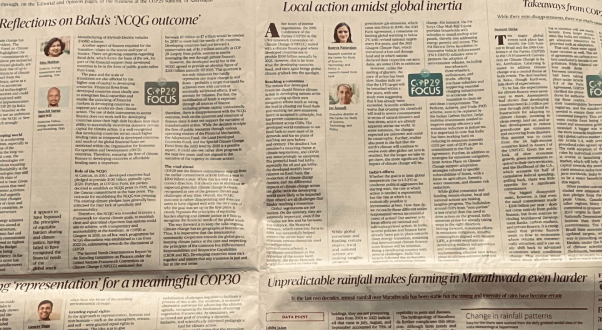
There were four center-page articles on COP29 conference held in BAKU in a major newspaper, pouring into the looming global warming crisis, the need for developed countries to spend more  on aid to help developing nations adopt climate change mitigation technologies,  and how we could be entering an era of NCQG - New Collective Quantified Goals.  One of them talked about India's major role in spending as much as 15000 crore rupees - about 0.06% of its GDP on renewable energy!! 


That we were about to breach 1.5 degrees Celsius rise (we are at 1.49 degrees C now) post commencement of the industrial age was mentioned in passing.  And 3.1 degrees Celsius temperature rise could be breached if we continue along this trajectory.  Barely a few months ago we talked about 1.5C rise as a defendable goal if only we went on a full court press.  It is unfortunate that we have an underpinning premise is that we have the answers, if only we had the will to deploy them; but the premise is simply not true.  One more reason to state the obvious.  We have been green washed.   This time from Baku.


Let us consider Renewable Energy, which decarbonizes the energy sector.  More than a decade ago, Photovoltaics (PV) reached a cost point where the installation costs per rated MW was on par with or less than new thermal power plants.  Wind energy was not far behind.  In India, investments in renewable energy outpaced conventional power for more than a decade, with approximately 70GW being added in thermal and 120 GW in renewable energy.  Renewable Energy accounts for 46% of installed capacity.  Yet in terms of energy generated thermal power is still a whopping 75% of the energy mix.  Renewable energy is seasonal (especially wind) and not 24x7 - Solar.  The ratio of delivered to installed capacity for renewable energy is about 30%.  Transmission losses are 2to 5% per hundred KM - so to put all solar in the deserts of Rajasthan is not practical.  To deliver 100% Renewable energy leveraging on energy storage while increasing capacity to compensate for the intermittency of renewable energy, one needs to triple the current renewable energy footprint.  We will struggle to find the land for that.  And battery-based solutions come at a prohibitively high cost (will quadruple the energy costs) and comes with its own carbon footprint which may take years to erase.   Pumped storage is often talked about.  It needs two reservoirs at different heights in reasonable proximity, with enough watershed to store the 1000s of MW of energy that needs to be stored.  Indias current hydro capacity is 10% of its total footprint and only a small fraction is amenable to pumped storage.  Pumped storage comes with massive ecological costs in terms of deforestation, and impact on aquatic life.  


In-spite of a decade of concerted action we are stuck with 75% of energy on tap coming from thermal power.  This conundrum is not unique to India, USA, China, much of Asia, and portions of Europe share this problem.  The exception is those blessed with 24x7 wind (Netherlands and Denmark) or those with massive legacy nuclear energy (France and Ukraine), that have breached the 50% ceiling of non-fossil energy-based power.  There is only one water-tight solution - that is nuclear energy, which is 24x7, minimal carbon footprint except during construction, and comes with a safety risk which is manageable.  Stray radiation from mining for coal or lithium exceeds that from standard nuclear plants.  Small nuclear reactors (SMR)are even more manageable when it comes to disposal of waste.  If the world is serious about climate change developed and developing nations should be forging a partnership in installing nuclear power plants, including SMRs which can be deployed quickly.  And this should have been one of the main talking points.


Moving to transportation, EVs that are not directly tied to solar panels rely on grid power which is now 75% thermal across much of the world.  The batteries come with its own manufacturing carbon footprint which is much higher than conventional vehicles.  The energy storage materials have a 3% extraction efficiency, some are mined at the expense of rainforests using primitive methods.  The total emissions footprint of battery manufacturing is estimated to grow to One Giga ton of CO2 per year - it is estimated that for a 100 KW powered EV (like a tesla) it would take 70000 KM of driving to neutralize manufacturing footprint.  Yet there is a case to be made for EVs if the energy used to charge is 100% renewable.   Two wheelers and three wheelers which take a few hours to charge and readily done in daylight could be 100% emissions free, and pollution free, if they are backed by dedicated solar energy.  For a 70KWh hour car it requires 10 KW of PV or at least two thousand square feet of space and eight to twelve hours of time to charge and finding that space is not easy in urban settings. The easiest answer for India is that it makes sense to electrify the two-wheeler segment and that is part of the policy prescription.  For the rest it is a struggle to electrify.  Increasing the percentage of biofuel, especially from waste, is the best mitigative answer unless one switches to nuclear energy instead of thermal power, which is clearly decades away. 


If the challenges are that stark, and immediately implementable solutions are that difficult, then the question is how societies can strive to mitigate climate change.  


Rooftop Energy.  This could include solar panels on rooftop or sunshades in every home, biowaste to energy in rural areas using small gensets, backed by tax breaks or subsidy from the government.   The goal should be that at least 40% of domestic energy needs in rural and urban areas is met by locally generated renewable energy.  This certainly would pose challenges to grid stability and thermal power plant reliability, but this can be managed.


Energy Efficiency:  The lowest hanging fruit has been plucked - much of urban lighting comes from LEDs which consume 10% of the energy of incandescent lamps.  Appliances are more efficient today than a decade ago, even in India.  However construction industry is locked into bricks and concrete even for non-load bearing structures - industrial waste to walls is a significant opportunity which needs to be tapped.

When it comes to thermal power, India is struggling to unlock itself from technologies which are inherently less efficient.  Existing coal fired Rankine cycle engines have 50% higher emissions as compared to combined cycle natural gas fired power plants.  However, India is a nett importer of natural gas.  Coal gasification, and coal to natural gas technologies need to be tapped and deployed with alacrity to reduce emissions from the energy sector.  Such a move would help India migrate from the less efficient Rankine cycle to the more efficient combined cycle which combines Brayton and Rankine cycles.


Optimizing India's farming:  Farming from existing irrigated lands or those areas blessed with abundant rainfall needs to be maximized and made scientific to maximize yields.  India has already closed the gap in wheat and is catching up in paddy.   Fifty percent of India's farmlands are not irrigated by rivers.  Large scale dependence on ground water is not sustainable or energy efficient.  India needs to switch to a combination of drip irrigation with millets, horticulture and agro forestry in such areas to maximize rural income reduce energy footprints in agriculture.  In a prevailing democracy such as India, such rules cannot be imposed from top, but there needs to be incentives from the government and markets. About 20% of horticultural produce is lost because of lack of cold storage.  The use of renewable energy (evaporative cooling) can be a game changer and needs to be developed for small farmers.  Finally agro-waste to ethanol needs to be developed so that Biofuels are sourced not just from water guzzling crops like sugar cane but actual agro-waste.  The farmer apart from being part of the food supply chain can become part of the energy supply chain with the right incentives for rooftop / pump head solar, and waste to energy or fuel plants.  By focusing on yields that reduce the area that needs to be farmed along with agroforestry, rural land banks could be coopted into nature-based climate change solutions with transparent policies that directly reward the farmer.  


Responsible Consumption:  India is a developing country - poverty is a lived reality.  When poverty exists in combination with caste and class divide, the loss of human dignity is morally unacceptable.  One needs to recognize that urban and rural consumption generates jobs in all sectors.  But there is a case to be made for responsible consumption.  This includes the shift away from larger fuel guzzling cars, frequent upgrades of electronic gadgets which have large manufacturing and transportation carbon footprints, investment in property which carries its own construction related emissions, and flying to destinations where surface transportation was possible to name a few.  About 10% of India's households now have first world lifestyles, and this is driving emissions.


It is said that if all of India lived in urban settlements such as New Delhi, then the entire population could be bottled into a small state such as Telengana.  Of course the country needs its farms and factories.  Therefore, while balancing technologies used for production of engineering goods and apparel, or food grains and horticultural products, one needs to ensure that land usage is kept to a minimum.  If we make substantial changes towards that end we may see more if India becoming a forest and contributing to mitigating climate change through nature-based solutions.


Until we do all the above Greenwashing will continue.


Saturday, November 2, 2024

Those lanes of inclusion


Our shop is as organic as it gets - has only grains, fruits, vegetables and dairy products. Short eats are locally made and certified as organic,  So for a shaving cream it needs to be an errand in sin to an inorganic shop, unless one uses an App for delivery.  But a part of me still would want to get out, past the leafy road to periurban Bangalore, all a hop away.  Cows on the road, strays near garbage, two wheelers and four wheelers in Brownian motion from gated apartments - I get to my inorganic shop - well stocked with detergents and soaps, along with food grains and junk food from assorted sources,  I would typically find smaller shops that sell peanuts and the like, a medical shop run by a disabled person - it breaks my heart to ask him for anything outside his reach, but he has a smile and he says he needs to make business.  Today the assorted shacks selling fruits and vegetables were closed, and I was determined to give the small timers a shot,  And so I head towards the main road and try and find push carts that had fruits.  They were gone,  I take a left  hit the main road and turn left to Anchepalya - another street in random motion with a mosque, temple, medical shops and shacks selling wares jostlling for space,

Guavas slightly bigger than a baseball caught my eye.  So I pulled over and stopped.  This guy had apples, oranges, guavas and bananas.  While oranges looked far from fresh the rest were good.  Got a Kg of each - I knew this guy would know hindi, spoke to him in Hindi, paid in cash for old times sake, and then my eyes wandered to the temple to his right.  He gave me an extra banana, peeling it saying this would be good.  It was.  The temple like the many small ones in Bangalore had a majestic tree.  It was 2 in the afternoon and it was closed.  On it steps there were kids playing.  Their mom in a burkha kept a watchful eye.  I had my bagful of fruits and a smile - these lanes can give social media a lesson.

In a couple of hundred yards, the road would turn to the right - and become less crowded, with a new temple to my right, a government urdu medium primary school which also hosts elections every time it is held, a Benedectine monastery to my left, it hosted a zen meditation retreat earlier this year.  Another left turn and I would be back to my leafy oasis.  Our new additional household help, a muslim lady went early on October 31st to buy firecrackers for her kids.   

Is it just my neck of the woods?  In Nilgiris where we are running an NGO the labourers, tribals from Masinagudi wanted a week off for Diwali.   The program was kicked off as per their custom with a puja for the implements that give them livelihood, while the staffers irrespective of whether they went to a church or a temple wanted to by firecrackers for the kids at home,

And so unfolds the mosaic of India, seen from a community called Mosaic.  The community is called Malhar Mosaic.  A song may be in order, but rendered by me would be surely unmusical.